
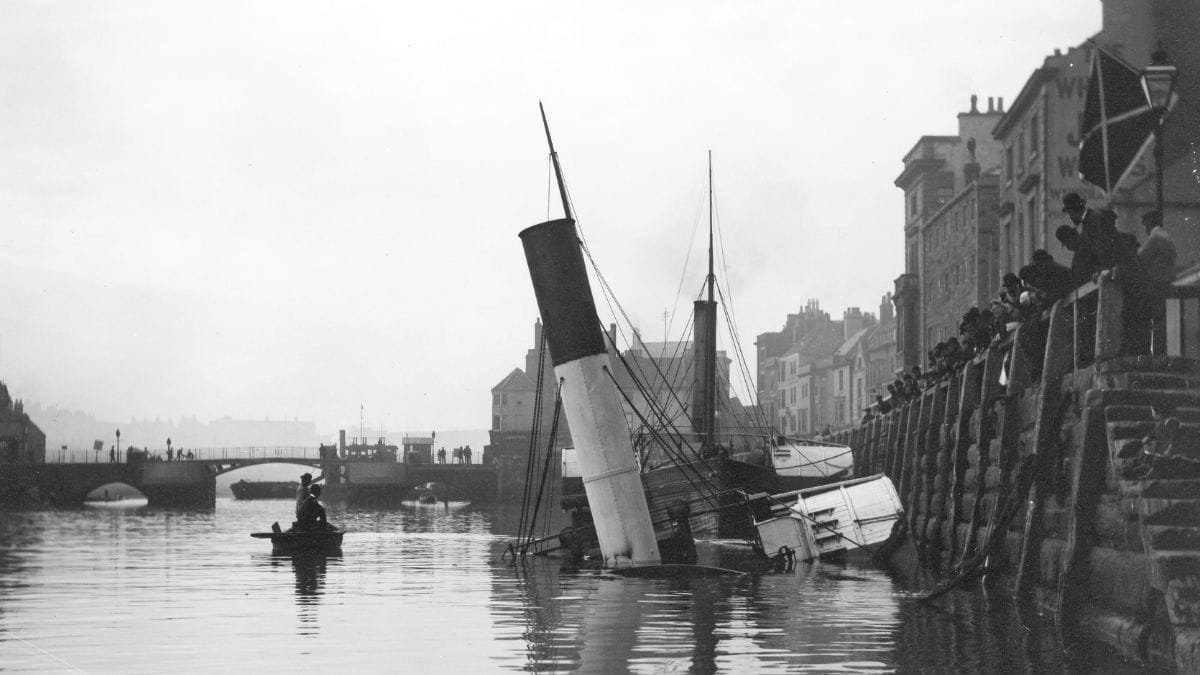
This particular Frank Meadow Sutcliffe photograph is one of his lesser-known images, but it has a compelling story to tell.
While browsing the Frank Meadow Sutcliffe prints at Whitby Museum, one particular image captured my attention. It portrays a steam tug, typically employed to guide boats into Whitby harbour, that has sunk off the harbour wall. Here's what we know about this extraordinary photograph, the people involved, and the sunken tug itself.
What was a steam tug? What were they used for?
The advent of steam tugs was a complete game-changer for shipping. These small yet powerful boats were strong enough to tow a much larger vessel in and out of a harbour. Transport by sea had changed forever.

Whitby Mini Guide
We have created a FREE mini-guide with all the essential information about Whitby, now available for instant download.
Before there were wind or oars, harnessing the wind by sail could move a ship across the ocean efficiently, but getting in or out of a harbour was no easy matter.
Cargo could be time-consumingly transported into the harbour bit by bit by smaller vessels, or the ship could wait for suitable wind conditions when sails, adjusted with great skill and precision, manoeuvred the ship just so into the dock. Days, even weeks, could be wasted, a cargo could perish, and the crew had to be fed and paid.
Early steam tugs
At the beginning of the 1800s, the potential workload of a wooden boat fitted with a steam engine, smokestack and wing paddle wheels for propulsion was beginning to be understood. Although it took several more decades for the idea to gain traction, it was boom time thereafter for the industry.
At least 360 steam vessels (not all tugs) were built on the Tyne before 1850 and most were paddle driven.
North Shields (with 149 vessels), South Shields (with 78 vessels) and Gateshead (with 63 vessels) were the principal centres for tug boat building at this time.
Eleven Tyne yards each built nine or more steamers before 1850, and a further eleven built four or more. However, in all, there were some sixty builders who built at least one of these early steamers.
Whitby's focus was more on steam colliers and ocean-going vessels rather than the smaller steam tugs. Nonetheless, steam tugs were welcome labourers for the harbour traffic. In one fell swoop, productivity was significantly increased.
The business was cut-throat
Tyne tugs would travel as far as Whitby, hoping to come across a ship looking for a tug. This practice was known as “seeking”.
It was fiercely competitive, and often a race ensued to be the first to get to a ship and offer a tow. The tug captain would have needed a skilful plan to evade other tugs with the same objective.
Lloyds List was a crucial source of information for the captain. It provided shipping news and details on ship arrivals, departures, and casualties – the key components in working a profit.
Steam tugs would pull up alongside the bigger ship to negotiate a deal with the captain. No doubt more permanent business contracts could be set up between ship owners and favoured tug operators.
Work was not limited to towing other vessels in and out of the harbour. There was towing work taking ships right along the coast, assisting in salvage operations, and transporting passengers and goods from ship to harbour.
Vast quantities of coal
A steam tug like contest carried 10-20 tons of coal that, for longer journeys, would sometimes even be stored loose on deck. Forty sacks of coal make one ton. That is about 400 to 800 sacks of coal, all to be manually shovelled into the boilers.
The volume of coal a tug could carry would determine the distance it could travel. The cruising consumption of fuel would be far less than the towing consumption. The towing consumption was determined by the size of the ship it was assisting and the weather conditions.
A captain out seeking needed a good feel for how much fuel would be used and how long the tug could be out at sea. Crew numbers varied, but for a tug out for several days, it might consist of the captain, engineer, 1st and 2nd mates, two firemen, and a young deckhand/cook.
The two mates and two firemen stoking the boilers could have worked three-hour shifts, meaning they would have done 4 days' work in 2 days. The captain and engineer had no one to replace them and would have been on duty all the time. It was exhausting work and not without hazard.
Huge amounts of coal were consumed. The chimneys belched out thick black smoke, ultimately ensuring that the townspeople of Whitby thoroughly disliked steam tugs. I should imagine Mr Wright was less than pleased at the black smoke outside his jet shop!
What do we know about the steam tug in Frank Meadow Sutcliffe's image?
We know she was called Contest, the Contest of Shields. Whitby Museum kindly found the name among their collection of photos.

The accident
The crew were asleep. The paddle box became caught under the harbour side, and as the tide came in, the tug heeled over and flooded with seawater. The crew made a quick escape.
On 17th August 1872, the Whitby Gazette published the following notification under the heading STEAM TUG SUNK.

How was the Contest repaired?
“As the tide fell, the water was pumped out, and the vessel found to have sustained little damage.”
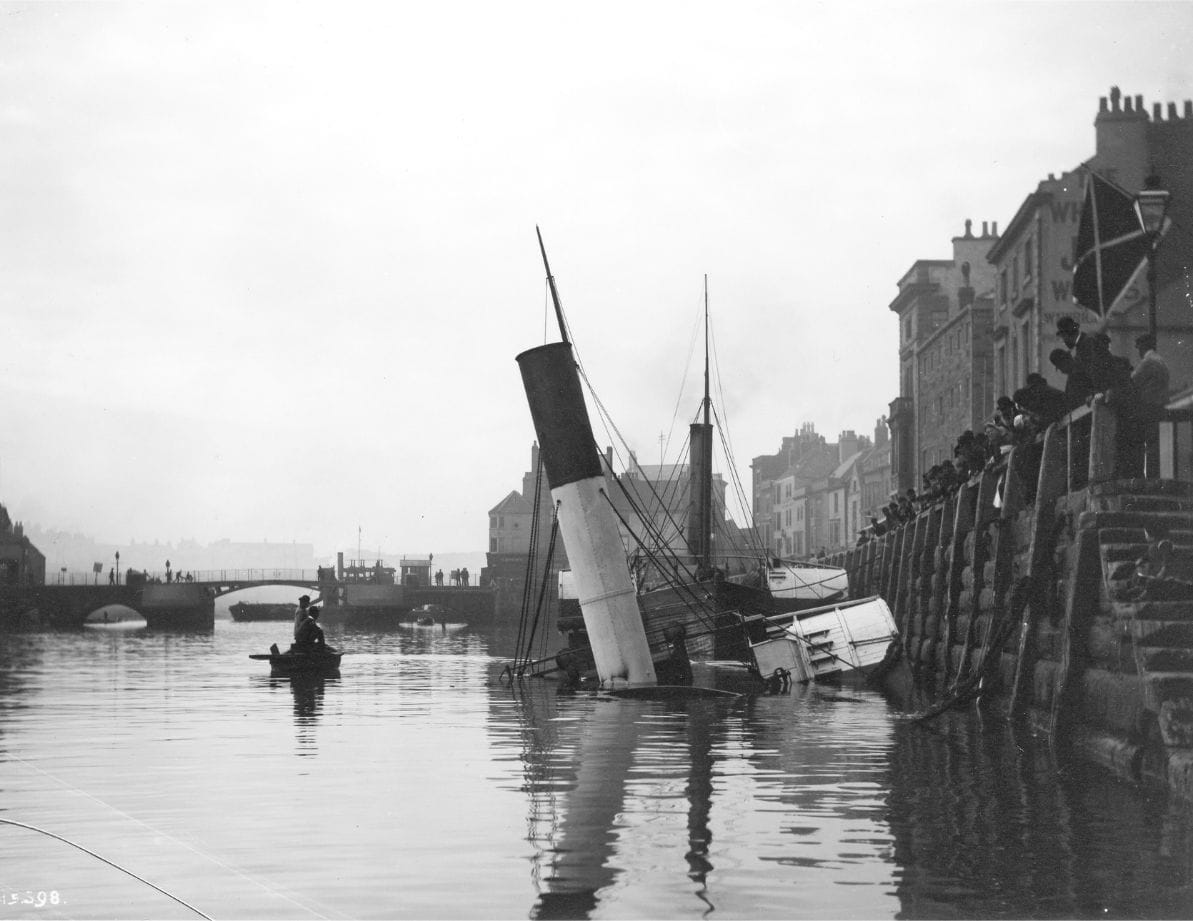
In the image, two gentlemen are sitting in a small rowing boat nearby. They appear to be viewing the Contest, perhaps assessing the damage and working out how to begin pumping.
The engines were of a simple construction; a return to Shields for repairs would not have been necessary. Ample shipyards or engineering works in Whitby were able to do the work. The damage might have meant drying out the boilers and little else.
Above the note about Contest, the launch is announced of the screw steamer “Robin Hood” built by Thomas Turnbull’s shipyard at Whitehall. The Whitehall shipyard was just beyond where today’s shipbuilding and marine engineering company Parkol is situated. Perhaps the Contest was repaired at the Turnbull yard.
“A good deal of chaffing” on Marine Parade
Take a closer look at the image. The Contest is moored, or half sunk, alongside the Marine Parade. On the wall of what is now the Moon and Sixpence, semi-obscured by the flag and lamppost, is written: Whitby Jet Works Wm. Wright.
This is William Wright's jet shop. His workshop is adjacent. You may well know Frank Meadow Sutcliffe's iconic photograph of the workshop, featuring bowler-hatted gentlemen working on jet pieces, standing around a bench, and a young boy stoking a stove in the foreground.

This area of the harbourside was a common mooring site for the steam tugs. It is possible that among the crowd looking over the railings are some jet workers.

Mr Wright himself reports that “a steamboat was laying alongside the staith and there was a good deal of chaffing going on by the crew”. Staith and Staithes derive from Old English, meaning landing place.
He goes on to complain about “disturbances created by the crews of north country steam boats” who “procured drink before closing time and took it on board their boats so as to continue drinking to a late hour”.
Mr Wright's complaint was 5 years after the Contest sank in the harbour, yet it is easy to imagine a similar scene in the days of the Contest.
More about Contest
The informative website Tyne Tugs lists three 19th-century steam tugs named Contest that had been built in either North Shields or South Shields.
Tyne Tugs agreed that the steam tug in the image was most likely to have been the 1856 Contest, which was built by Hepple and Landells of North Shields. It was launched in 1856 and was finally broken up in 1892, a working life of 36 years.
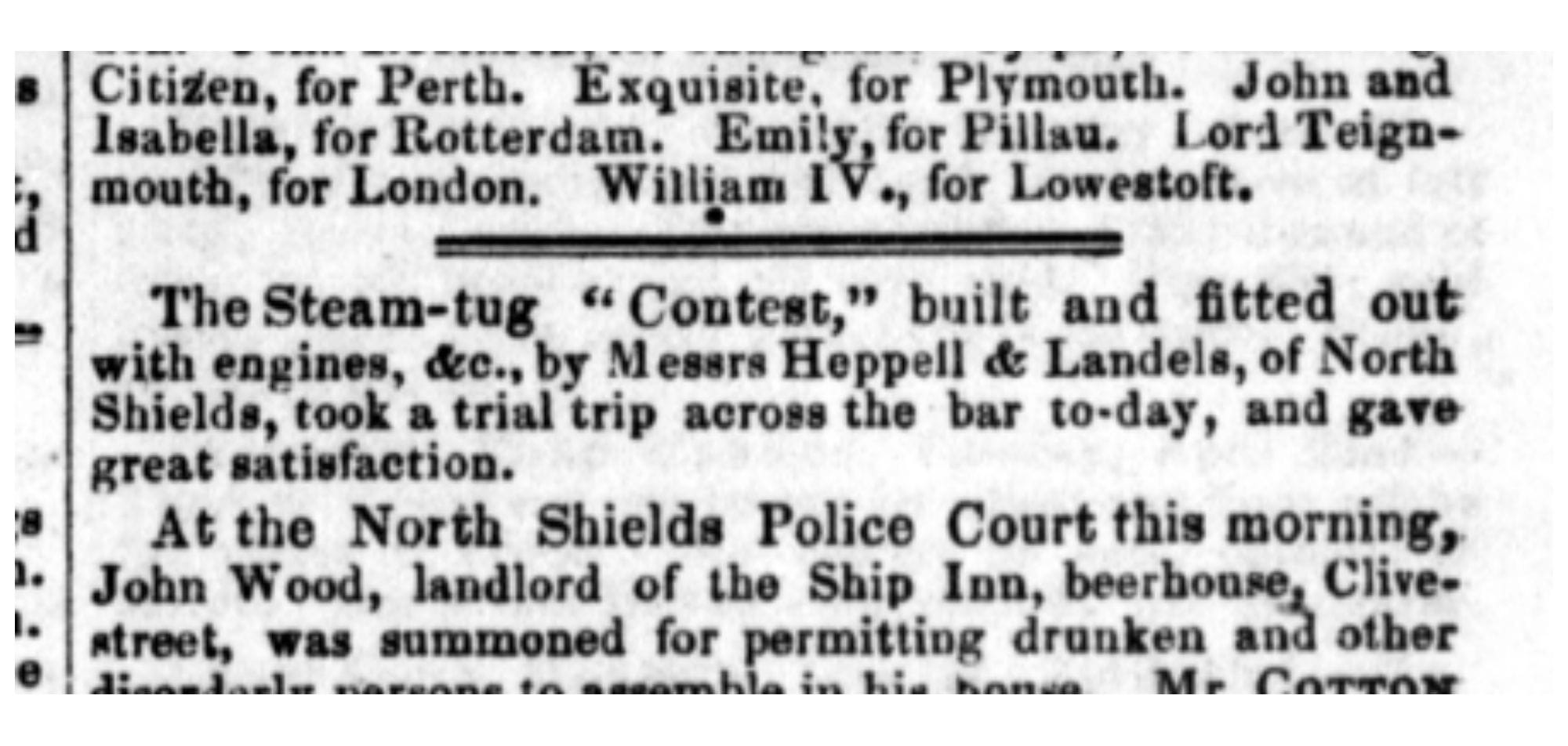
She was initially registered further up the coast at Leith, Edinburgh, and was owned for about the first 10 years by Helen Stoker & Co, a business that owned and operated several tugs, which appears to have been in partnership with a whole raft of both male and female family members and associates, including George Jamieson.
From 1872 onwards, she was registered in North Shields and owned by steamship owners William Minto, then John Minto, and finally Thomas Boag, also a steamship owner.
In the year of the Whitby incident, ownership changed from William to John Minto, which raises the question of whether the accident was related to this change.
Who took the photo?
The photographer was Frank Meadow Sutcliffe. In 1872, he was only 19 and taking the first steps in what was to be a career that achieved an international reputation in his lifetime, and is now regarded as one of the masters of late 19th- and early 20th-century photography.

News of the Contest sinking must have spread fast and so Sutcliffe made his way down to the harbour. It would have been important to rescue the Contest as soon as possible, so there would not have been much time. Sutcliffe's camera equipment was heavy and extensive: a huge mahogany stand camera, a case containing his glass plates, and a developing tent.
The photograph would not have been to accompany the newspaper article. It would be a couple more decades until photographs were routinely printed in newspapers.
The photo was likely taken for his own collection and the learning process. There were four other photographers in Whitby at the time. It's possible the scene features in their work too.
The crowd
A crowd of about 30 people gathered to gaze at the unfortunate steam tug. A row of Bowler hats follows the curve of the wooden railings along the parade.
Blurry sections indicate movement: the conversation and speculation must have been lively. If only we could hear what they were saying. A lone young child sits on the steps, its mother probably the lady with the white apron, not far away.
Look closer and other workday activities appear, a guy up a ladder, someone pushing a sack barrow over the bridge.
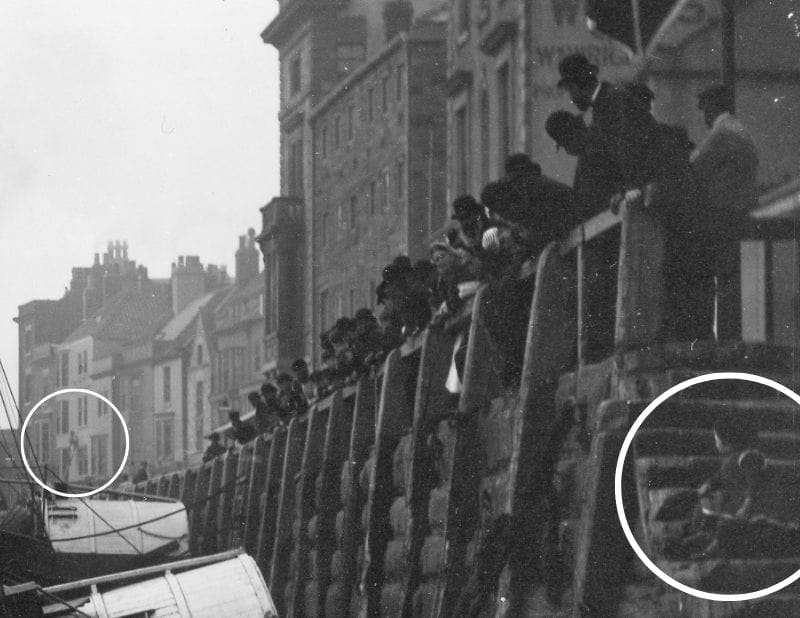
The photo captures Whitby life in August 1872. It is one of those images where the more you look the more you see of life over 150 years ago. Steam tugs were an integral part of the hustle and bustle of daily life.
About the Author
This post was written by local resident Ruth Denison.
- F. M. Sutcliffe photo with permission of Whitby Museum
- Newspaper clippings content provided by THE BRITISH LIBRARY BOARD. ALL RIGHTS RESERVED with thanks to The British Newspaper Archive.
- Hiley, Michael 1974, Frank Sutcliffe: Photographer of Whitby, paperback edn. 2022, The History Press, Cheltenham.
- Lloyds List
- Tyne Tugs






Related Posts