

Did you know there are over 530 wrecks off the coast of Whitby? Among them is the SS Rohilla Shipwreck, which has a fascinating story behind it.
The SS Rohilla, a passenger steamer owned by the British India Steam Navigation Company, was built for service between the UK and India and later converted into a troopship. It was a hospital ship during the First World War until tragedy struck in October 1914. The vessel ran aground near Whitby, resulting in the loss of 83 lives. Here is further information about the SS Rohilla Shipwreck.
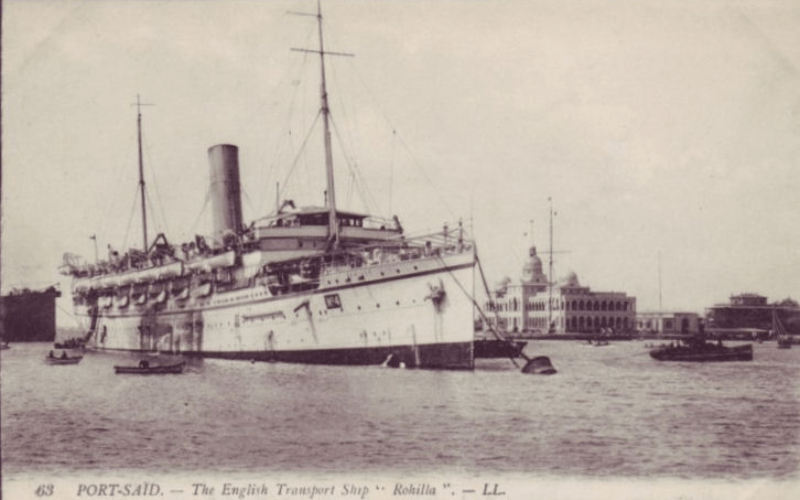
SS Rohilla Shipwreck
The Rohilla was called up at the outset of the First World War and converted into a naval hospital ship. HMHS (His Majesty's Hospital Ship), but she had only a short life in that role.

Whitby Mini Guide
We have created a FREE mini-guide with all the essential information about Whitby, now available for instant download.
A 3-day rescue mission
The three-day rescue mission of the SS Rohilla resulted in the tragic loss of 83 lives and marked the end of the era of rowing lifeboats. The ill-fated hospital ship, carrying medical staff and wounded soldiers, departed from Scotland on October 30th, 1914, headed for Dunkirk. However, violent storms diverted the steamer off its intended course.
In wartime blackout conditions, the SS Rohilla was hit by a severe Northeast gale and ran aground on a reef just a mile south of the harbour. Despite the captain's belief that they were miles from the Yorkshire coast, they were perilously close to Whitby and its treacherous cliff rocks.
The tragic tale of the “Three-Day Rescue” of the Rohilla remains a powerful local story. The wreck now rests just off Saltwick Bay Nab.
The lifeboats
The harsh conditions presented significant challenges for the rescue efforts. Despite the difficulties, six lifeboats—the John Fielden, Robert and Mary Ellis (Whitby), William Riley of Birmingham and Leamington (Upgang), the motor lifeboat Bradford Middlesbrough, Queensbury Scarborough, North Yorkshire—were involved in the rescue operation.

Among these, the motor lifeboat Henry Vernon Tynemouth played a pivotal role in rescuing the remaining survivors and attempting to approach the wreck.
The rescue
Over the three days, some of those who attempted to swim to safety in the raging seas were rescued, though many were lost, and lifeboats were able to rescue others. Numerous stranded individuals leapt into the water in an attempt to swim to safety.
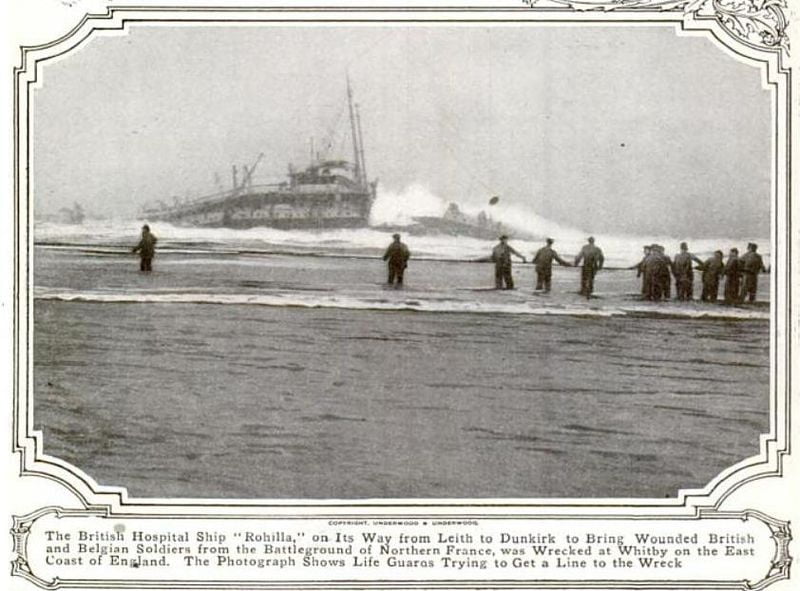
Calls were made to neighbouring lifeboat stations but faced the same stormy conditions. That didn't stop them from trying, though. Hundreds of men lowered a lifeboat down a cliff in the shadow of the town's Abbey, but the boat could not launch.
Many left on the Rohilla became desperate and jumped into the sea. People of Whitby began forming a human chain and waded into the shallows to help those who made it to shore.
Survivors of the SS Rohilla
In all, 146 of the 229 on board, including Captain Neilson, all the nurses, and Titanic survivor Mary Kezia Roberts, survived.

Church bells rang across Whitby to mark the end of the rescue mission; people wept at the sight of those brought back to land.
Though 146 people were saved, the disaster was a turning point for the RNLI. It made lifeboat crews realise the future lay in engine power instead of rowing boats.
Mary Roberts
Mary Roberts, a stewardess from Liverpool, was one of the survivors of both the sinking of the RMS Titanic in 1912 and the ill-fated Rohilla in 1914.
Despite enduring two major maritime tragedies, the sinking of the Rohilla was particularly harrowing. Survivors had to endure horrendous gale conditions and the ship slowly breaking apart, in complete contrast to the relatively settled sea conditions during the Titanic's sinking.
One might have expected that after surviving two such losses, Mary Roberts would have chosen a different career path. However, she continued.
Captain Nielson believed that the ship had struck a mine before grounding. An inquest jury exonerated Nielson from all blame. It recommended that all passenger vessels carry rocket apparatus rather than rely on rockets fired at the ship from shore and that a motor lifeboat be stationed at Whitby. You cannot visit this shipwreck on foot. However, divers still visit the wreckage of the Rohilla.
Please note: We have used Wikipedia to reference this article because numbers and details vary widely from source to source. (SS Rohilla)









_grounded_1914.JPG)
I can say with certainty that 89 souls of the 234 on board perished. The reason for my insistence is that I have spent decades researching the tragic tale and writing two books on the subject.
Herbert Burton is my relative and I’m currently researching him so I would really appreciate any information regarding him or his heroic rescue on the motor lifeboat the henry vernon please