
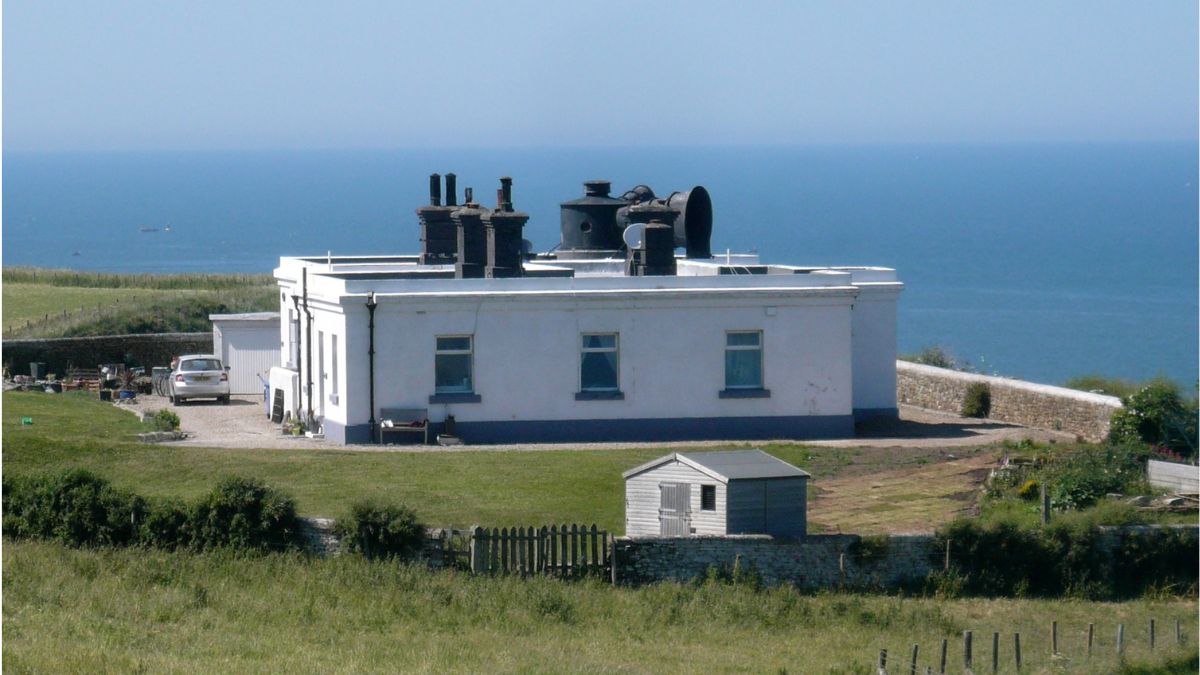
Do you remember Whitby's fog horn and lighthouse when they were still in use?
Many of you will remember Whitby's two lighthouses just off Saltwick Bay. You might even remember hearing the eerie blasts of Whitby's Fog Signal, which we can only compare to sounding like a distressed bull! Here is the history of Whitby's fog horn and lighthouse.

Whitby High Lighthouse
The Whitby High Lighthouse, constructed in 1858, has safeguarded sailors for over a century. With its distinctive white octagonal brick tower, James Walker of civil engineers Messrs. Walker, Burgess & Cooper skillfully designed this impressive lighthouse.

Whitby Mini Guide
We have created a FREE mini-guide with all the essential information about Whitby, now available for instant download.
The remaining half of the two towers
The Whitby High Lighthouse, operated by Trinity House, is the remaining half of a pair of towers initially positioned in a North-South alignment. They were collectively referred to as the twin lights of Whitby.
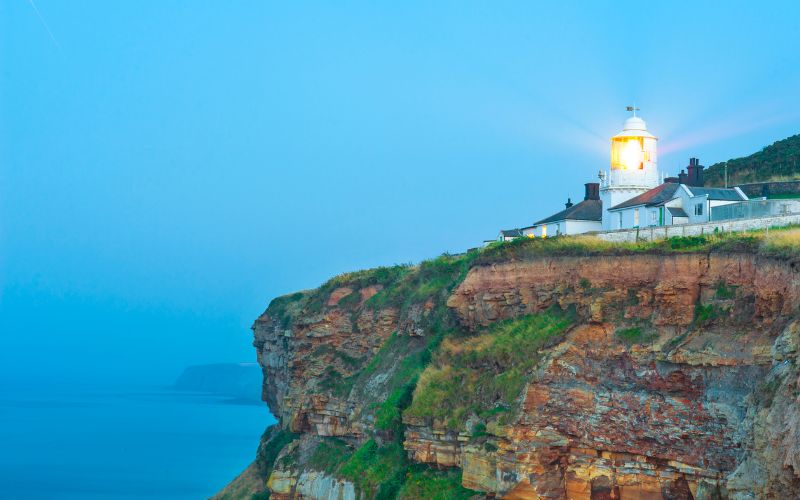
The North Light was of a similar octagonal design to the surviving South Light but taller at 20.5 m (67 ft) (so that, although the North Tower was on lower ground, the two lights were on the same focal plane) These lights were initially used to provide a fixed pair of beacons to alert ships to the hazards of Whitby Rock.
Each lighthouse was furnished with paraffin lamps, and a pair of single-story keeper's cottages were connected to each tower.

In 1890, Whitby High Lighthouse was replaced with more efficient lights. An occulting mechanism eclipsed the light once every thirty seconds, and a red sector marked Whitby Rock.
The South Lighthouse is the only one that remains. The North lighthouse was demolished, and the fog signalling apparatus took its place.
Whitby High lighthouse was electrified in 1976 (after which the ‘Hood' paraffin vapour burner, which had been the active light source until that point, was donated to the Whitby Museum. The light was automated in 1992.
The keeper's cottages still stand and are available to rent. This is a fantastic place to enjoy a holiday or short break! You can book them here.
The Whitby Fog Signal
After experimenting with different types of signals at St. Catherine's Lighthouse in 1901, Trinity House decided to utilise sirens at Whitby. These were sounded through a pair of ‘Rayleigh Trumpets,' named after the scientific advisor at the trials.
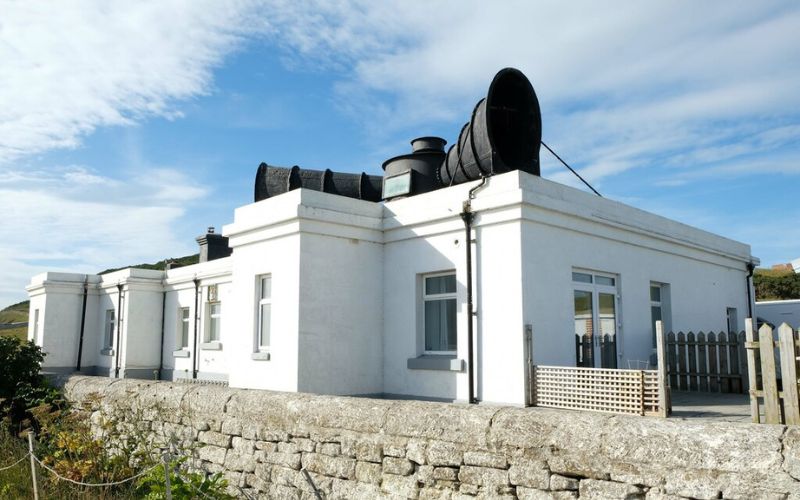
Over the next decade, Trinity House installed similar equipment at several other lighthouse locations.
The Whitby Fog Signal, locally known as the ‘Hawsker Bull,' was operational from 1903 and remained in use until 1987. The equipment was updated in 1955. Each trumpet, 20 feet long and 8 feet high, was mounted on the engine room's roof and set about 120º apart.
Two horizontal 25-horsepower oil engines compressed the air needed to activate the horns. The siren blasted four times every ninety seconds and you could hear it up to 10 miles away.
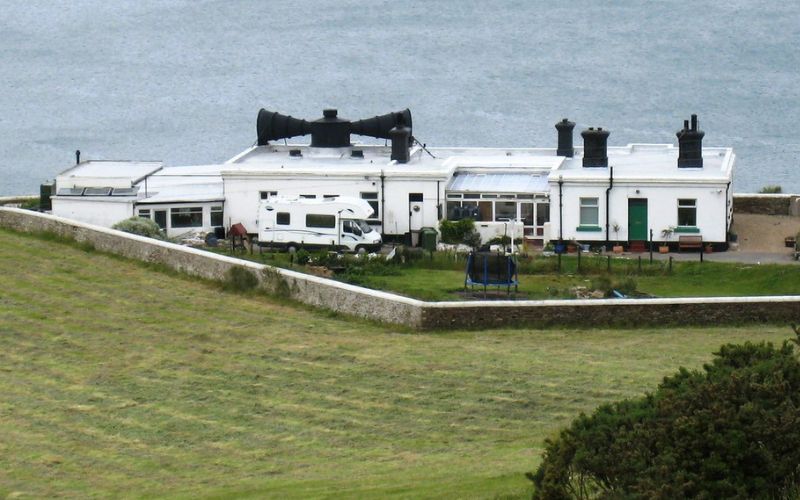
After a review of navigational aid requirements, the siren at Whitby was discontinued in 1987. Initially, plans were put forward for an electric emitter stack, but this never occurred.
The redundant fog signal building sold and is now a home and holiday accommodation called Hornblower Lodge.
We hope you have found this article interesting. These iconic landmarks are enduring symbols of the town's connection to the sea. As technology continues to evolve, the significance of these historic structures serves as a reminder of the enduring legacy of Whitby's maritime history.
Header image credit: © Copyright Mark Percy and licensed for reuse under this Creative Commons Licence.






Related Posts