

We uncover the intriguing history of Whitby Abbey, from Viking invasions to literary legends.
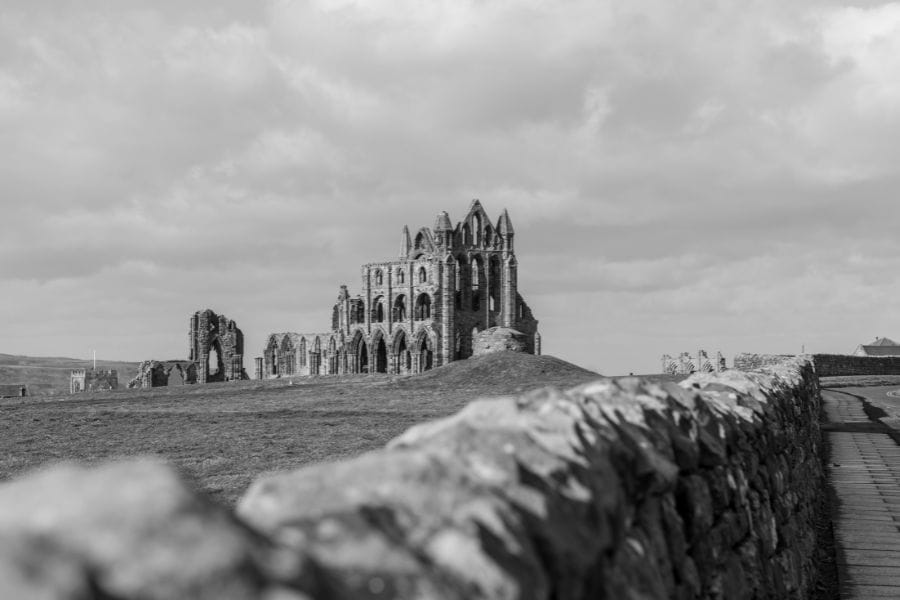
The Whitby Abbey ruins are one of North Yorkshire's most iconic landmarks. Established around 657, the original monastery emerged as a pivotal religious hub within the Anglo-Saxon realm. It was here in 664 that the notable Synod of Whitby took place. It marked a significant moment in the evolution of the Church in England.
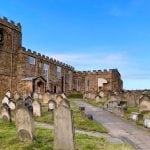
Today, the site is crowned by the remnants of the 13th-century church belonging to the Benedictine abbey founded in the wake of the Norman Conquest. Here is the history of Whitby Abbey.

Whitby Mini Guide
We have created a FREE mini-guide with all the essential information about Whitby, now available for instant download.

Prehistoric and Roman Whitby
Excavations indicate that the Whitby headland was inhabited during the late Bronze Age. Archaeologists discovered a roundhouse within a ditched enclosure near the cliff’s edge, along with several artefacts from that era.
Additionally, it’s possible that a Roman signal station occupied the Whitby headland in the 3rd century AD. This location lies strategically between known signal stations at Goldsborough and Ravenscar, overlooking the mouth of the River Esk.
However such a signal would have likely succumbed to coastal erosion. The cliffs in this area gradually fell into the sea over time.
The first monastery at Whitby Abbey
The first monastery was founded in 657 AD by the Anglo-Saxon era King of Northumbria, Oswy (Oswiu). He appointed Lady Hilda, Abbess of Hartlepool Abbey and grand-niece of Edwin, the first Christian King of Northumbria, as founding abbess.
The first incarnation of the Abbey
The first incarnation of the Abbey under St Hilda lasted 200 years. At this time, the North East of England was invaded by the Danes, or as they are more commonly known—Vikings!
The invasion of the Danes wrought great destruction across the region and led to the fall of the Abbey. For the next 200 years, the Abbey was derelict, deserted, and destroyed by the ravages of time.
The next incarnation of the Abbey
The next incarnation of the Abbey was in the 11th century, shortly after the Norman Conquest. These ruins remain today. The story goes that a Norman knight travelled to England with William the Conqueror.
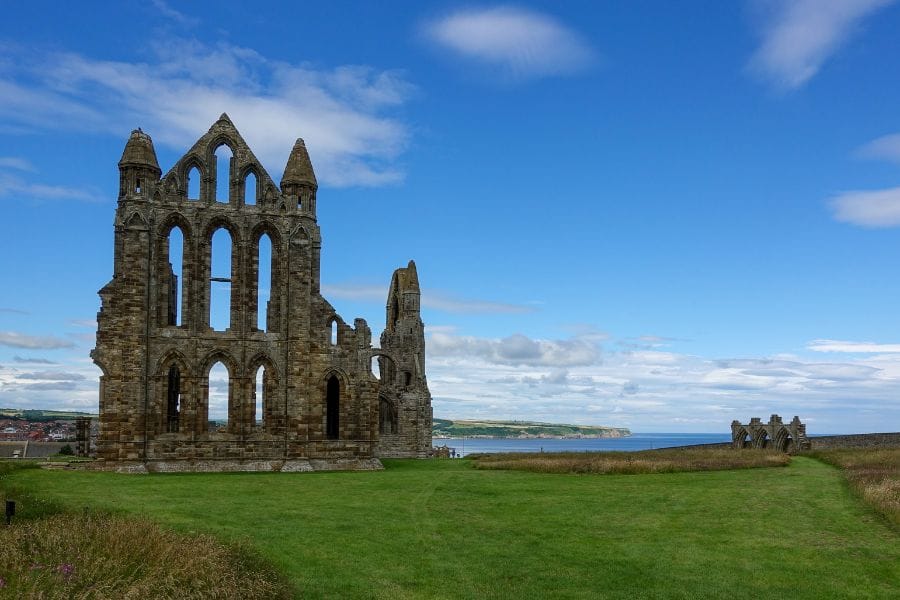
After witnessing many bloody battles to defeat the rebellious Anglo-Saxon lords in the north of the country, he became a monk. In 1067, with the generous help of local lord William de Percy, Reinfrid founded the second Abbey at Whitby. This new Benedictine institution was at first merely a priory. It was granted Abbey status only in the early 12th century.
In this guise, the Abbey performed many services to the local community, providing for their religious needs through the running of churches, employing many people, and supporting local crafts and industries in the area.
Suppression of the Monasteries
The age of monasticism was about to come to an abrupt end. In the South of England, a process known as the Suppression of the Monasteries began in 1509. Numbers were dwindling in the great monastic houses. Novices were in short supply, and many religious houses were merged to ensure survival or sold to turn the assets into cash for use elsewhere.

It was in this way that Cardinal Wolsey had planned for a great college at Cambridge to be named after him. Henry, however, now King had other ideas. Wolsey failed to secure a divorce on behalf of the King from Catherine of Aragon, and the Cardinal fell from grace. King's College, Cambridge, was thus named for the monarchy rather than the Catholic Church.
On the 14th December 1539, Henry VIII ordered Whitby Abbey to close. The dissolution of the monasteries had reduced the old way of life to dust. The result of a whimsical monarch demanding everything go his way.
Closure of the Abbey
Upon closure, Whitby Abbey was stripped of all its valuable fixtures and fittings, including glass from the windows and lead from the roof, and left to decay. The roof of the great church and the central tower eventually fell, leaving behind the ruins we know and love today.

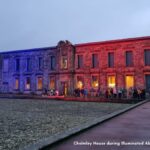
During the First World War, in December 1914, a German battlecruiser shelled Whitby from the North Sea, destroying the west wall and nave. Locals caused further damage, scavenging material for their own building projects and gardens, much as others had done before them. The Cholmley family built an impressive private house adjacent to the Abbey; they plundered the ruins heavily in making this grand residence.
Remembered at the Abbey is the First English Poet
It is through the contribution of Caedmon, who is remembered at the Abbey and St Mary's Churchyard with a cross that Whitby lays claim to a literary first.

Caedmon was a Northumbrian who cared for the animals at the double monastery of Whitby Abbey during the abbacy of St. Hilda. According to the 8th-century historian Bede, he was initially ignorant of “the art of song” but learned to compose one night in a dream.
He later became a zealous monk and an accomplished and inspirational Christian poet. Caedmon was the first English poet whose name is known, and Whitby was the birthplace of English literature.
Establishing the Date of Easter
The first Synod of Whitby took place to establish the date of Easter. The story goes that in a toss-up between the Ionan practice followed by Irish monks and the Roman tradition favoured by Rome, the decision was settled by Oswui.
King Oswui asked both sides if they agreed that St Peter had been handed the keys to the kingdom of Heaven by Christ and pronounced as ‘the rock' on which the church would be built. Because St Peter was the Church's highest authority, it was conceded that Roman tradition was kept.
199 Steps to St Mary’s Church and Whitby Abbey
The 199 steps, known as the Church Stairs, lead from the Old Town up to St. Mary’s Churchyard. The first known record of the steps is from 1340; however, it is believed the steps were actually made a long time before this.

Some historians believe that St. Hilda used the steps to confirm the faith of her followers. This was a test of Christian faith for those who wished to worship in St Mary’s Church. The steps were originally made of wood and stood for hundreds of years. In 1774 when they were replaced with Sneaton Stone.
Before the 19th century, when St Mary’s was still open for burials, there was a tradition of carrying coffins up the steps. Rather than take the journey in a horse and carriage along Green Lane. Relatives of the deceased would climb the 199 Steps with the coffin.
Can you imagine how extremely tiring carrying a body up 199 steps would be? Therefore, wooden planks were built at intervals to place the coffin and give the pallbearers a rest. Official pallbearers weren’t always used. As per tradition, men were carried by their male companions, women by female friends and family, and children by children.
So, are there 199 steps?

Despite their name, there is a lot of dispute about how many steps there are. Some people believe there are 198 because you shouldn’t count the final step to the top. Others believe 200 because of the step from the bottom onto Church Street. Every 10th step and the last are numbered with Roman numerals, so you no longer have to count them.
If you have ever walked up the 199 Steps, you’ll know what a challenge they can be!
Whitby Abbey serves as a reminder of its monastic past and an essential site for archaeological and historical studies. It reflects the enduring significance of religious institutions in shaping communities and cultures. The Abbey is a testament to the enduring power of history. It is great to explore it's storied ruins and contemplate the centuries that have shaped this iconic landmark.






Love the place in my younger days used to come fishing had a boat with a friend paddy Harkin these were the days todays my dear daughter Zoe live up hear so I come up to she her and I really love it when am hear hear and Blackpool my to favourite places