

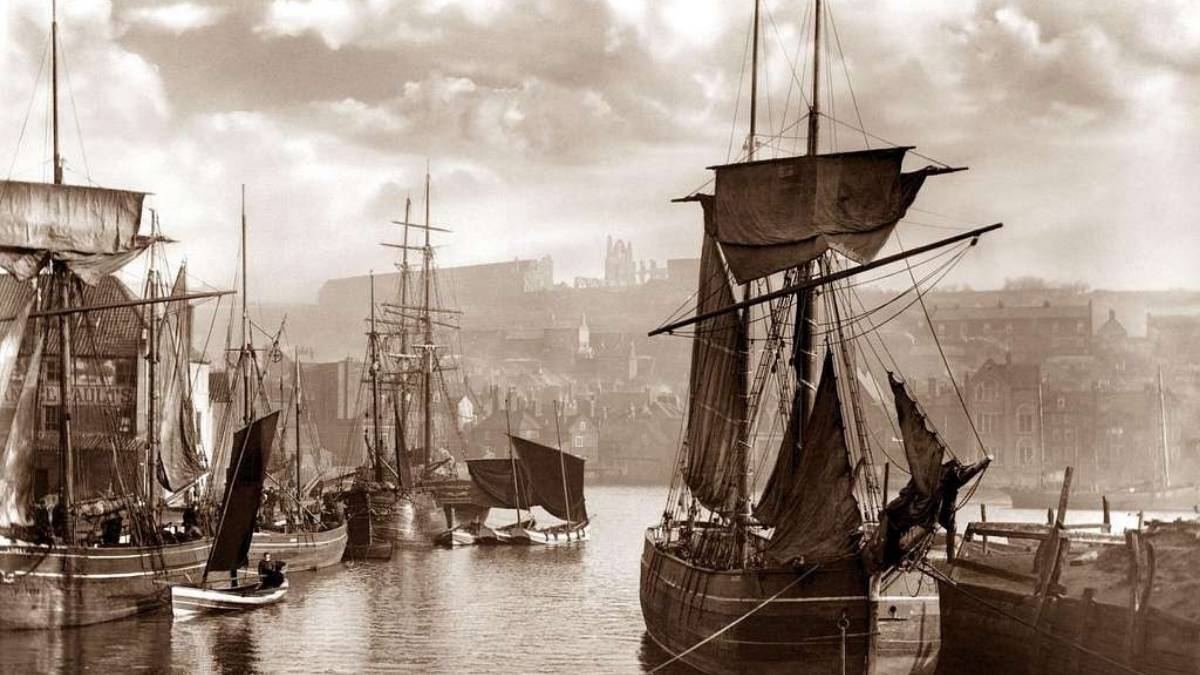
Whitby is a fascinating place to visit and learn about its history. Here, we explore its history and ways you can learn more about this seaside gem.
Whitby's history is fascinating and includes ties to Dracula, Whaling, and Captain Cook. This small coastal town still reminisces about its past and boasts quaint cottages, a ruined Abbey, and a harbour with fully functional lighthouses. While Whitby represents the typical fishing town, its history sets it apart.

How was Whitby founded?
The Brigantes were a Celtic tribe that controlled large sections of Northern England. They were initially called Whitby, Sinus Fari. By 71 AD, the Romans conquered Whitby. Eventually, the settlement became known as Streonshalh when the then-Christian King of Northumbria, Oswy, founded a monastery and Abbey there.

Whitby Mini Guide
We have created a FREE mini-guide with all the essential information about Whitby, now available for instant download.
Whitby was a fishing settlement in the following centuries until the 18th century. It developed as a port and centre for whaling and shipbuilding—trading in locally mined alum and manufacturing Whitby jet jewellery. Whitby's rich cultural and historical heritage today contributes to the local economy.
Did Vikings invade Whitby?
In 867 AD, Vikings came to Whitby and destroyed the monastery. They renamed the area ‘Hvitabyr,' meaning ‘the settlement belonging to Hviti.' Later, the name was changed to the modern name Whitby. The Vikings eventually settled peacefully in Whitby, previously known as Streanshalh.
More information on the name Whitby
The earliest record of a permanent settlement in Whitby was in 657. Whitby was then known as Streanæshealh. Streanæshealh could have meant Fort Bay or Tower Bay, or Streonas settlement. As a nod to the origins of its name, many B&Bs and private properties boast this name to this day. Whitby comes from the Old Norse word Hwitebi, which means ‘white settlement'. The name Whitby came into use in the 12th century.
A brief history of Whitby Abbey

As far as modern history is concerned, the event that marked the birth of Whitby is the construction of the Abbey in 657AD by Oswy (612–670), King of United Northumbria.
It was indeed at the Abbey that, in 664AD, it was decided that the local Church would adopt the Roman calendar during the Whitby Synod. Furthermore, the appointment of Hilda, 614–680, granddaughter of King Oswy, as the abbess of Whitby contributed to maintaining Whitby's status as an essential and strategic hub on the religious and political fronts.
Indeed, thanks to her wisdom, kings and peasants came to her to seek counsel, and she had a significant following of the devout. Legend has it that she was the one who encouraged Caedmon, known today as one of the earliest English poets, to develop his talent upon overhearing his stories and poems as he would watch over his herd by the Abbey.
Whitby Abbey today
In the 1920s, the Ministry of Work took over, and today, English Heritage takes care of the still extensive remains. Much diminished from the original building, but enough survives of Whitby Abbey to leave a lasting impression on visitors of what was one of the most stunning monuments in the monastic tradition of Old England.
Whitby’s whaling past

In the 18th century, the whaling industry was a dominating presence in the town. Its history is marked now by the famous Whalebone Arch. Successful boats returned to Whitby with the jawbones of their best catch hoisted on the lower spars and a garland at the mast.
Most whales could be used. The tail produced glue, and the bones were ground down to make manure. Bone from the whale's mouth was used to create umbrellas or ornaments, and the hair of the whalebone was used as stuffing.
The bustling harbour was known for the odious stench associated with rendering blubber from whales in oil production. The fat was brought back in barrels and refined by boiling it for lighting, soap, leather preparation, and other purposes. Even the fenks, the refuse of fat, were used to make manure, Prussian blue and ammonia.

This image is far from the one we know and love today. However you feel about Whitby's whaling history, thanks to the prosperity derived from the whaling industry, the Pannett Park area owes its existence. The grand mansions of Bagdale and St Hilda's Terrace were built on the fortunes of the blubber business.
A dangerous industry
Whaling was a dangerous industry in which many locals were employed. The boats weighed 350-400 tonnes and carried forty to fifty crew members. They also had 25-foot-long rowing boats to chase the whales. Many ships were capsized, crushed by ice, or men froze to death. Despite the risks, crewing a Greenland whaling vessel offered money and adventure to many men in the town.
Captain Cook

You probably know that Whitby's history is connected to Captain James Cook, 1728-1779, born in Marton, a few miles from Whitby. However, did you know that the famous navigator began his maritime career in the Whitby whaling fleet? Only 18 years old, he started working as a merchant navy apprentice for John and Henry Walker, two Quaker brothers who owned a few ships.
(On your next visit, visit the Captain Cook Memorial Museum housed in Walker's old house).
Thanks to his charting and navigation skills, Cook quickly climbed ranks and was at the command of his ship before he decided to leave Whitby for the Royal Navy on board HMS Eagle in 1755. Having reached the rank of Master, Cook assisted with the capture of Quebec. At the end of the Seven Years' War, he took over the direction of British overseas explorations. In 1766, he embarked as commander of HM Bark Endeavour for the first of three Pacific expeditions. Captain Cook is also known for his voyages of discovery and charting, including New Zealand and Australia's coast.
He was also the first man to sail around the world completely, and at the time of his death, he was on a mission to find the North West Passage.
Whitby's fishing past

Aside from its whaling past, Whitby is famous for its lucrative herring fishing. Today, you can still find some delicious kippers, such as Fortune’s Kippers, a traditional smokehouse still operating.
Whitby's jet mining history
Whitby’s coastline is also home to a seven-and-a-half-mile length of one of the earliest gemstones, Whitby Jet. The jet from Whitby has been dated back to its use by crafters during the Bronze Age and remained popular enough that there were Jet crafting workshops opened in 1808.
Many dangers were associated with mining the ample jet supplies in Whitby, and the great demand for the gemstones led to a shortage around Whitby. There are still believed to be large stores under the hills along the shore, but these cannot be accessed easily.
Most of the early jet used was exposed to the high winds and pounding surf against the shoreline, and many believe that the hidden stores will remain there until they are again exposed by nature. View our recommended Whitby Jet shops.
Connections to Bram Stoker's Dracula

In addition to the maritime successes, Whitby is well recognised because it is the location chosen for Bram Stoker’s Dracula. Stoker commonly stayed at the Royal Hotel in Whitby. During one of his stays here, the story of Dracula was born. This has led to Whitby becoming known as a gothic town in nature. It is also the twice-yearly home of the Whitby Goth Weekend, a festival for Goths to meet and celebrate gothic culture.
Further your learning at Whitby Museum

The Whitby Museum houses over 6,500 specimens of fossils and minerals, making it the most extensive collection of Jurassic eras from the Yorkshire coast in the world.
Here, you will find bones and fossils from giant marine reptiles, plants, and mollusc animals, such as ammonites, making any fossil enthusiast rejoice. It might be small, but it has many exhibits from Whitby's history to discover.
Let us know in the comments if you have any interesting facts about Whitby's history.






Does anyone know the history of St Hildas terrace, in particular the large Georgian house that used to be council offices.(Mariners house) I’m told that it was built about 1816 by a sea captain.
I grew up in Whitby, and I too had to study the port of Whitby in the last year of primary school. My memory isn’t waist it was but it could have been Captain William Scoresby. Who had this built. His portrait hangs in the museum in Panet Park museum. He is the Great Granddad eight time removed of a friend of mine. I have asked her if she knew of any properties he had built but she didn’t. I’m sure there’s a house in Bag Dale road with a blue plaque on saying he lived there.
Hi
Just wondering if anyone can recommend a book on the history of Whitby – one with lots of photos/sketches would be great. I’d like to give it to my daughter for Christmas; we live in Australia but have ancestral connections in Whitby and surrounds. Thanks
Hi Debbie. Thanks for getting in touch. I haven’t read any personally but ill ask our Facebook followers to see if anybody can recommend anything for you. Tom
I’ve only just seen this, and I’m probably too late, but I grew up in Whitby and in the last year at primary school we read The Port of Whitby which was interesting.
Thanks Tom I’d appreciate that.
Hi Debbie. I haven’t had much response from the Faecbook group regarding this. The only suggestions I has was “Whitby Yards Through Time” which you can find on Amazon here – http://www.amazon.co.uk/Whitby-Yards-Through-Time-Whitworth/dp/1848686056
I hope this helps.
can’t wait to visit again, without Covid lurking of course – a truly beautiful & historic place. Love it.
Does anyone have any information on Burnham Mill which was on Cock Mill Beck close to the River Esk. My Gt Gt Gt grandfather, Francis Burnand, was the miller there. He died in 1852. I have the tithe map but little else. Any information would be gratefully appreciated.
Lynne (New Zealand)
Looking for Larpool Cottage.
I stayed in the 1940s at a cottage which “may” have had that name. The cottage overlooked the RIVER ESK.
The Front Door was on the first floor opening onto a lane.
We climbed a stile near the town and walked along a river path to reach the back door of the cottage. Once inside a flight of stairs led to the bedrooms and the front door.
.
My late wife, Joyce Nellist was born in Whitby in 1936. On her birth certificate it mentions “Sundial Cottage” Quay Road. I have visited Whitby but have never found Sundial Cottage. I know that she spent her early school days here before the family moved north to Redcar and eventually Middlesbrough. I am not sure where to look for further information, I would just like to know the site of the property.